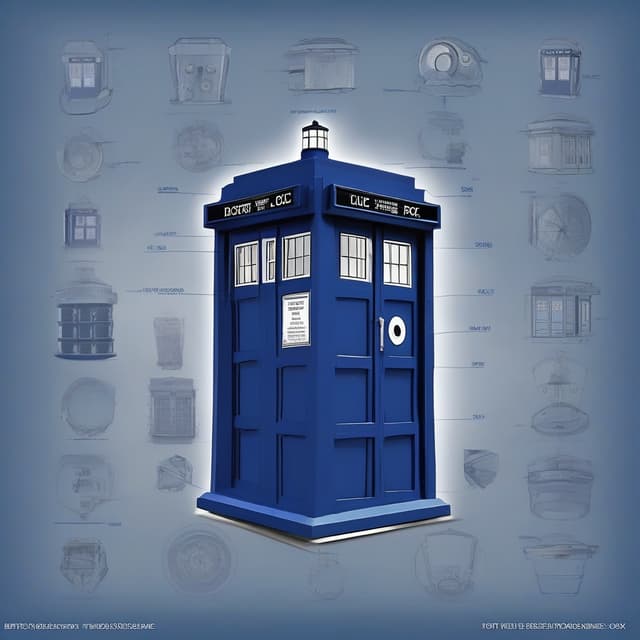
| Genre | Science fiction |
| Title | Doctor Who |
| Premise | Adventures of a heroic scientist and explorer known only as 'the Doctor' who investigates scientific mysteries and makes groundbreaking discoveries |
| Lead actors | Various actors portraying the Doctor |
| Original run | 1952 – 1972 |
| No. of seasons | |
| No. of episodes | |
| Country of origin | |
| Original language | English |
Doctor Who was a British science fiction television series that aired on the BBC from 1952 to 1972. The show centered around the exploits of a brilliant scientist and explorer known only as "the Doctor," who investigated scientific mysteries and made groundbreaking discoveries across the globe and beyond. Unlike the time-travelling alien of the same name in our timeline, this version of the Doctor was a fully human protagonist.
The series was created by Sydney Newman and produced by the BBC's Science Consultancy Unit, which aimed to create educational and scientifically-oriented programming for television. The original pitch for Doctor Who envisioned an anthology-style show where each season would feature a new actor portraying the lead "Doctor" character, whose real name was never revealed.
The first season, which debuted in 1952, introduced the audience to the original Doctor, played by actor Cedric Hardwicke. This incarnation of the character was a brilliant yet eccentric scientist and explorer, who would travel the world and even into space to uncover new discoveries and solve scientific mysteries. Early episodes blended elements of adventure fiction, mystery, and speculative fiction with an educational bent.
While the premise and supporting cast of Doctor Who remained largely consistent over its 20-year run, each new season featured a different actor taking on the lead role of the Doctor. This allowed the show to explore a range of scientific specialties and personality types within the same overall framework.
Some of the most acclaimed seasons included:
As the show progressed through the 1960s, the storylines grew more grounded and scientifically rigorous, focusing on real-world exploration and discovery over fantastical elements. The Doctor's adventures often served as a vehicle to educate viewers about fields like oceanography, aeronautics, and meteorology.
Despite critical acclaim and a loyal following, Doctor Who was cancelled by the BBC in 1972 after 20 seasons on the air. The network cited declining viewership and a desire to shift towards more contemporary, socially-conscious programming.
However, the series left a lasting mark on British television and science fiction. Its use of a rotating lead actor pre-dated other long-running anthology shows, and its commitment to scientific accuracy and education was unique for the genre at the time. Many later science fiction shows, from Space: 1999 to Cosmos: A Personal Voyage, drew inspiration from Doctor Who's grounded, educational approach.
While the original Doctor Who series never achieved the sustained popularity and longevity of its counterpart in our timeline, it remains an influential and fondly-remembered piece of British television history. Its legacy as an early exemplar of "hard" science fiction on the small screen endures to this day.
